

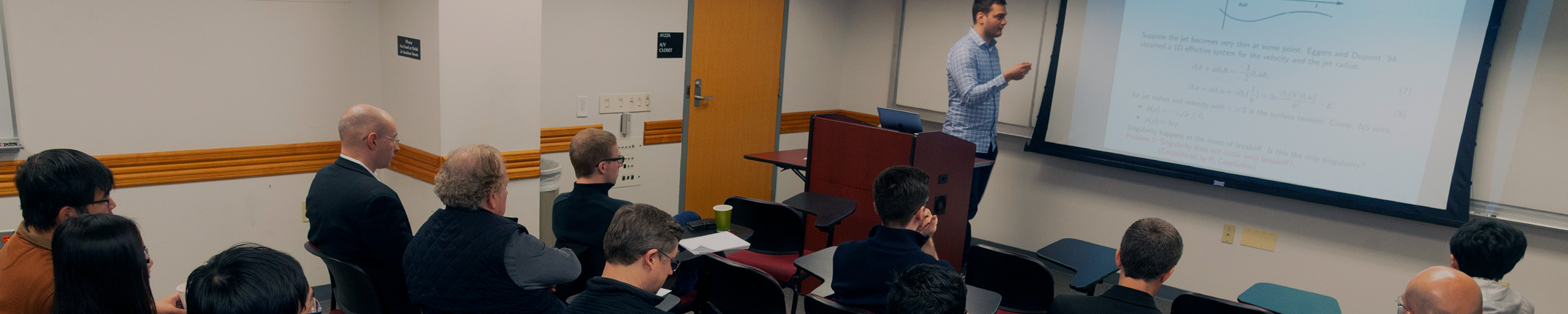
Special Seminar by Noel Gutierrez-Brizuela, 12/2/2026
Special Seminar
Noel Gutierrez-Brizuela
Max-Planck-Institut
Title
The parameterization paradox: when do oceanic small scales matter for climate?
Abstract
Climate models cannot succeed without parameterizations of oceanic small scales. Most climate theories, however, do just fine without accounting for small scales. This is the parameterization paradox: small scales are crucial for simulation, yet seem not to matter for understanding.
I will argue that the paradox arises because climate dynamical frameworks take shortcuts that models can’t. Could better understanding emerge from frameworks that faithfully track how simulations work?
As a concrete example, I will focus on the Pacific equatorial cold tongue and the theories we typically use to explain it. I will show when those theories break down and how they differ from the physics of climate simulations. As an alternative, I propose a theory of cold tongues that is based on the energetic cost of lifting dense water. This framework is far more consistent with simulated physics and therefore gives parameterized processes a central explanatory role.
Bio
Climate models are extremely sophisticated computer programs that reproduce the physics ruling the ocean, atmosphere, and other components of the Earth system. However, the theories and diagnostic frameworks that we use to explain climate simulations are based on idealizations that strip away the vast complexity that supports the models' realism and skill.
My work seeks to narrow the gap in complexity between climate models and climate theories, with particular focus on explanations of the ocean's role in climate. To achieve this, my work borrows methods and concepts from ocean mixing and stratified fluid energetics, and uses them to build a thorough understanding of how ocean models take up and redistribute heat, and what impacts that heat has on the broader ocean circulation.
Lately, my work has focused on the dynamics of the Equatorial Pacific Ocean, and the generation of near-inertial internal waves by storms. Since arriving at MPI-M, my group and I have also started working to better understand the Southern Ocean response to external forcing.
Contact
If you are not subscribed to seminar announcements and need a link to this online seminar please contact aosc-helper. You can also subscribe to weekly links and announcements below.
AOSC Seminar
Pre-seminar refreshment: N/A
Seminar: 3:30-4:30pm, Room: ATL 2400(only when in-person)
Meet-the-Speaker: 4:30-5:00pm, Room: ATL 3400(only when in-person) [For AOSC Students only]
[ Subscribe to receive seminar announcements | Email aosc-deptseminar@umd.edu to give a seminar ]