$3.25M from the State of Maryland Matches $4M Gift for Two Eugenia Brin Endowed Chairs
The new endowed chairs at UMD will conduct research in Parkinson's disease and data assimilation.
The University of Maryland’s College of Computer, Mathematical, and Natural Sciences (CMNS) will receive $3.25 million from the Maryland E-Nnovation Initiative Fund (MEIF), a state program created to spur basic and applied research in scientific and technical fields at colleges and universities. The funding will partially match a $4 million private donation to establish an endowed chair in Parkinson’s disease and another in data assimilation to improve weather prediction or climate studies.

The Maryland Department of Commerce funding will match the gift from Mathematics Professor Emeritus Michael Brin to honor the memory of his late wife, Eugenia, a NASA research scientist who worked on advancing weather and climate prediction. Eugenia was diagnosed with Parkinson’s disease in 1998 at age 50 and passed away in 2024. Mother of Sergey Brin (B.S. '93, mathematics and computer science) and Samuel Brin (B.S. '09, computer science), Eugenia was a leading advocate of research into the neurodegenerative disorder that destroys the brain’s dopamine-producing neurons and impairs motor control and cognition.
“Eugenia devoted her career to climate science, and after her Parkinson’s diagnosis, she became equally committed to advancing research on the disease. This gift is intended to honor both of those passions,” Michael Brin said. “I am delighted that the University of Maryland and the state of Maryland are partnering to build lasting strength in these fields that have the potential to improve lives in profound ways.”
The Brin family’s newest gift supports Forward: The University of Maryland Campaign for the Fearless, a $2.5 billion fundraising initiative that aims to expand access to UMD’s world-class education, accelerate groundbreaking research and build stronger communities.
“These two new endowed chairs represent a powerful commitment to academic excellence and will help our college attract exceptional faculty members whose teaching, mentorship and research will drive discoveries in environmental science and in the understanding and treatment of Parkinson's disease,” said CMNS Dean Amitabh Varshney. “We are deeply grateful to Michael Brin for this heartfelt gift honoring his late wife’s memory and to the state for matching his investment.”
Eugenia Brin Endowed Chair of Parkinson's Disease
UMD will recruit a new faculty member to the university to hold the Eugenia Brin Endowed Chair of Parkinson's Disease at the University of Maryland Institute for Health Computing (UM-IHC). The chair will apply advanced computational approaches to the study and treatment of Parkinson’s disease—one of the most prevalent neurological disorders with more than 1 million people diagnosed in the United States annually.
“For this chair, we’re looking for someone who can bring artificial intelligence and machine learning technology, bioinformatics and other large-scale, highly computational approaches to understanding the brain, disease progression and potential therapies,” said Adam Porter, co-executive director of UM-IHC and a professor of computer science at UMD.
Located in North Bethesda, Maryland, the UM-IHC merges computational, clinical and biomedical expertise to improve the health of Maryland residents and advance the state’s biotech industry.
“We are excited to advance a marquee program that intersects computer science and clinical medicine to tackle Parkinson’s Disease,” said Bradley Maron, co-executive director of UM-IHC and the Melvin Sharoky MD Professor of Medicine at the University of Maryland School of Medicine. “The time is right for bringing a fresh approach to understanding the basis and, thereby, potential treatments for this challenging disorder, and I have no doubt that the UM-IHC is the optimal place for success.”
The new faculty member will collaborate with faculty members at the University of Maryland, Baltimore and amplify a growing interdisciplinary effort at UMD and UM-IHC to better understand neurodegenerative diseases such as Parkinson’s and Alzheimer’s—and translate discoveries into improved patient outcomes. Meeting that challenge requires more than medicine alone. It calls for the combined power of artificial intelligence, molecular neuroscience, disease modeling, and immersive assessment and rehabilitation—areas of distinctive strength at UMD and UM-IHC.
Heng Huang, a professor of computer science with a joint appointment in UM-IHC, is using artificial intelligence to mine genomic, biomarker and cognitive data for earlier signs of Alzheimer’s and related dementias, while also improving the tools used to detect disease. Pratyush Tiwary, a professor of chemistry and biochemistry with a joint appointment in UM-IHC, is opening new therapeutic possibilities through RNA-focused research and innovation with potential applications across neurology and other disease areas.
Michael Cummings, an MPower Professor in the Department of Biology, is advancing Parkinson’s research through work spanning biology, wearable sensors and machine learning, including recent findings that link altered sphingolipid catabolism to lysosomal dysfunction in the aging brain. Ling Hao, an associate professor in the Department of Chemistry and Biochemistry, is uncovering the molecular drivers of Parkinson’s and Alzheimer’s disease to support the development of new treatments.
Varshney, a professor of computer science, has collaborated with faculty at the University of Maryland, Baltimore, to develop tools to help clinicians compare patient groups across many measures and track how those groups change over time, work that supports efforts to identify meaningful disease subtypes in Parkinson’s. His work also extends into immersive technologies that create new possibilities for training clinicians, capturing movement and neurological symptoms with greater precision, and delivering evidence-based rehabilitation for patients with Parkinson’s and other neurodegenerative disorders.
Michelle Girvan, a professor of physics, applies network science and machine learning to identify Parkinson’s subtypes and predict how disease may progress, helping lay the groundwork for more personalized treatment and better-designed clinical trials. Ricardo Araneda, a professor of biology, probes how dopamine and noradrenaline shape brain circuits and is investigating loss of smell as a potential early indicator of neurodegenerative disease.
By building on these existing strengths, the new Eugenia Brin Endowed Chair of Parkinson's Disease will deepen collaboration across the campuses and further elevate UMD and UM-IHC as leaders in neurodegenerative disease research.
Eugenia Brin Endowed Chair in Data Assimilation
UMD will recruit a new faculty member to the university who conducts data-assimilation research to improve weather prediction or climate studies to hold the Eugenia Brin Endowed Chair in Data Assimilation in the Institute for Physical Science and Technology (IPST).
“Weather and climate forecasting depend on the quality of data being used by the models,” said Wendell Hill, professor and director of IPST. “This new chair lets us bring in a cutting-edge researcher who can advance the science of translating raw observations into usable predictions at a moment when both the volume of data available and the stakes for getting predictions right are rising very rapidly.”
The new Eugenia Brin Endowed Chair in Data Assimilation will join a university with exceptional momentum and long-standing distinction in atmospheric and oceanic science. Ranked No. 4 in meteorology/atmospheric sciences among public U.S. institutions by U.S. News & World Report, UMD is home to faculty members who helped define the field of data assimilation for more than three decades, while also advancing research in numerical weather prediction, Earth system modeling, oceanography, atmospheric chemistry, air quality and climate science.
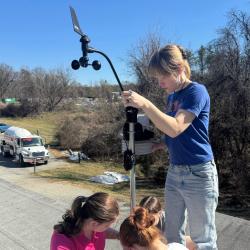
Their work is amplified through major partnerships with the state of Maryland, NASA and the National Oceanic and Atmospheric Administration, including efforts that improve forecast accuracy, strengthen environmental monitoring, support climate resilience, and enhance public safety through initiatives such as the Maryland Mesonet and Maryland HydroNet.
The new chair will build on a legacy shaped by the late Eugenia Kalnay, a global leader in numerical weather prediction and data assimilation, and by Distinguished University Professor Emeritus of Mathematics and IPST James Yorke (Ph.D. ’66, mathematics), whose pioneering work in nonlinear dynamics helped forge new connections between chaos theory and meteorology.
That foundation is carried forward by faculty members in IPST and the Department of Atmospheric and Oceanic Science (AOSC), whose work spans ocean and atmospheric dynamics, hazardous weather prediction, climate variability and advanced data assimilation methods.
Kayo Ide, an associate professor of AOSC with a joint appointment in IPST, studies atmospheric and oceanic dynamics, including data assimilation, prediction, transport and mixing. AOSC Associate Professor Jonathan Poterjoy develops advanced data assimilation methods for hazardous weather forecasting, with a focus on high-uncertainty events such as tropical cyclones and severe convective storms. In 2024, Ide and Poterjoy joined the new Consortium for Advanced Data Assimilation Research and Education (CADRE), which focuses on improving data assimilation in the U.S. and bringing students up to speed on a complex area of study that few people have mastered, creating a high demand for data assimilation specialists.
AOSC Professor James Carton is a physical oceanographer known for designing ocean data assimilation systems and for research on ocean, sea ice and atmosphere interactions.
Distinguished University Professor of AOSC Sumant Nigam advances understanding of climate variability, ocean-atmosphere interactions, drought, monsoons and long-term climate change through observational analysis and dynamical modeling.
With this depth of expertise already in place, the Eugenia Brin Endowed Chair in Data Assimilation will have an opportunity to immediately accelerate discovery, foster new collaborations and help define the future of data assimilation at UMD and beyond.
Longtime Supporters
Collectively, the Brin family’s long record of philanthropic support of the university totals some $65 million. They have been making gifts to CMNS since 2005, beginning with an endowed chair in the Department of Mathematics, where Michael worked for 31 years. They have since endowed six additional chairs and professorships in CMNS. Their latest gift also included $1.08 million for the Eugenia Brin Endowed Lectureship in Meteorology and Data Assimilation for an ongoing lecture and symposia series through the Earth System Science Interdisciplinary Center.
A $4.75 million gift in 2021 established the Brin Mathematics Research Center, expanding and spotlighting UMD’s mathematics and statistics research excellence nationally and internationally. The center attracts hundreds of mathematicians to the university every year for workshops, summer schools and distinguished lectures. The Brins endowed the math center in 2024 with a $27.2 million gift that also established two new endowed professorships in mathematics and launched the Brin Maryland Mathematics Camp.
The family also established the Michael Brin Prize in Dynamical Systems, the Brin Postdoctoral Fellowship program and the Michael Brin Graduate Student Endowed Fellowship program, all in mathematics; and the Brin Family Aerial Robotics Lab.