

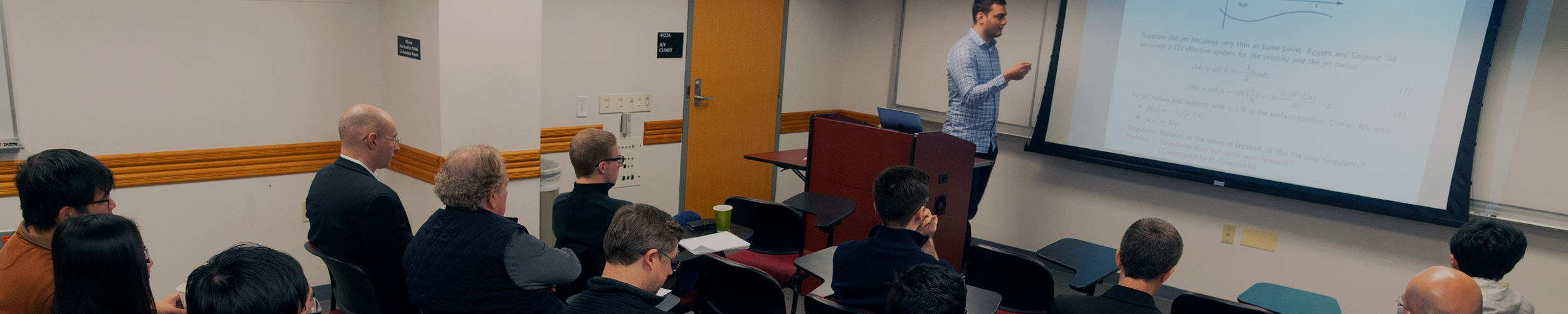
AOSC Seminar by Oreste Reale, 10/1/2026
AOSC Seminar
Oreste Reale
SSAI/NASA/GSFC
Title
Observing System Simulation Experiments (OSSEs) as a pre-requisite for real-time weather forecasts on Mars: How to apply to Mars what we have learned on Earth
Abstract
Human exploration of Mars will require an operational weather forecast capability. Uncertainties at the landing sites are on the order of tens of kilometers, partially due to inadequate knowledge of synoptic variations of vertical profiles of atmospheric density, wind and dust concentrations. Routine operational weather forecasts for Mars could reduce such uncertainties and would also enable the prediction of various atmospheric phenomena including dust storms, which pose a serious threat to robotic and manned missions.
The creation of an operational real-time weather forecast capability for Mars is a daunting task, which will need a critical mass of observations, a data assimilation system, and an atmospheric model. While there are several excellent models of the Martian atmosphere, and the capability of assimilating data in these models does exist (incidentally, pioneering work on Mars Data Assimilation was initiated in the AOSC by Eugenia Kalnay and her former student Steve Greybush), the fundamental obstacle is the limited number of observations. To establish the type and specifics of observing systems which would be more beneficial, there is a methodology called Observing System Simulation Experiments (OSSEs). OSSEs are routinely performed for the Earth to assess a priori the potential benefit of a future observing system, as opposed to OSEs which are used to evaluate the impact of an existing observing system.
An OSSE framework for Mars allows to: a) answer fundamental questions about Martian weather’s intrinsic predictability and establish the type and number of observations that would enable a prescribed forecast skill level, b) optimally design the network of observations to minimize cost, and c) address from the beginning a fundamental problem of atmospheric data assimilation: observational error correlation. To be beneficial, observations must be properly distributed: assimilation of data from oversampled inactive parts of the atmosphere is harmful to the forecast skill. Benefits consequent to an OSSE framework for Mars will be the selection of orbital characteristics, data types and sampling strategies that minimize error correlation.
Dr. Reale was interested in the possibility of Mars weather forecasting since 2015 and initiated exploring the feasibility on a Mars OSSE framework with internal company’s resources. Since 2022, he has been overseeing the development of the SSAI IRAD program, that supports Mars OSSEs research. In 2025, NASA GSFC decided to co-fund this activity. Now a Goddard OSSE framework for Mars has been constructed, thanks to the involvement of a large team composed by Planetary Scientists in the NASA GSFC Solar System Exploration Division, Penn State University, American University, and SSAI.
The talk will describe the various components of the Goddard Mars OSSE framework: the data assimilation and forecast system, the Nature Run, and the tools to extract synthetic observations from it. The current ongoing work will be presented, including evaluation of the Nature Run, test assimilations with existing data sets, and experiments to assess the predictability of the Martian atmosphere. Dr. Reale has more than two decades of experience on the subject of OSEs and OSSEs, and contributed to the evaluation of different Nature Runs used for Earth OSSEs.
Bio
Dr. Reale has been working at Goddard as a contractor since 2001, focused on atmospheric dynamics, modeling and data assimilation, numerical weather forecasting, impact of dust on atmospheric dynamics, and observing system simulation experiments (OSSEs). In addition, he has a lifetime interest on Mars, and he is currently contributing, within the GSFC Solar System Exploration Division, to the development and use of a Mars OSSE framework whose goal is to determine the requirements of an observational network that would enable a real-time weather forecast capability on Mars. Special emphasis is placed on: 1) Mars models intercomparison, 2) predictability limits of the Martian atmosphere; 3) scales of Martian atmospheric motion and and their seasonal dependence 4) impact of model resolution on topographically-induced atmospheric phenomena.
Contact
If you are not subscribed to seminar announcements and need a link to this online seminar please contact aosc-helper. You can also subscribe to weekly links and announcements below.
AOSC Seminar
Pre-seminar refreshment: N/A
Seminar: 3:30-4:30pm, Room: ATL 2400(only when in-person)
Meet-the-Speaker: 4:30-5:00pm, Room: ATL 3400(only when in-person) [For AOSC Students only]
[ Subscribe to receive seminar announcements | Email aosc-deptseminar@umd.edu to give a seminar ]