

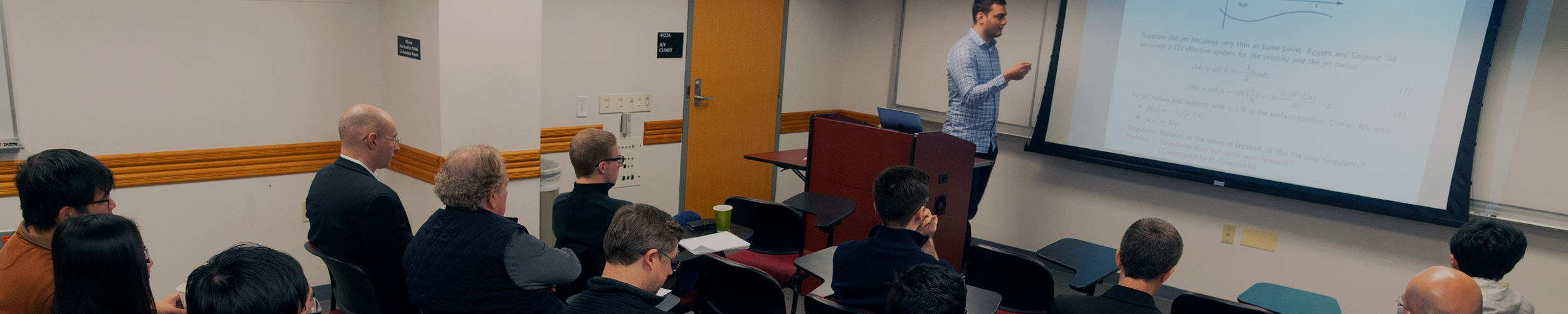
AOSC Seminar by Isaac Moradi, 10/8/2026
AOSC Seminar
Isaac Moradi
UMD/ESSIC and NASA GSFC/GMAO
Title
Advances in Microwave and Radar Data Assimilation for Improved Atmospheric Thermodynamics and Extreme Weather Prediction
Abstract
Accurate representation of atmospheric clouds and precipitation remains a major challenge in numerical weather prediction (NWP), particularly for high-impact weather systems such as tropical cyclones (TCs). Passive microwave observations provide valuable information on atmospheric temperature, moisture, clouds, and precipitation under all-sky conditions, while active radar observations provide complementary, vertically resolved information on the three-dimensional structure of clouds and precipitation.
This presentation demonstrates the importance of satellite observations from low-Earth-orbit (LEO) platforms for tropical cyclone (TC) prediction through observing system experiments using the NASA Goddard Earth Observing System (GEOS) model. These experiments show that withholding LEO observations can lead to substantial degradation in TC forecasts, particularly in track prediction. We further discuss how high-revisit observations from inclined orbits can improve temporal sampling in the tropics and provide additional information between observations from polar-orbiting platforms. Data assimilation experiments using the NOAA Hurricane Analysis and Forecast System (HAFS) further demonstrate that assimilating these observations can improve TC forecasts, particularly for storm intensity.
We will then discuss efforts to advance the assimilation of passive microwave and active radar observations in NWP systems. The Community Radiative Transfer Model (CRTM) has been enhanced with hydrometeor scattering capabilities developed using the discrete dipole approximation technique and a new radar forward operator to enable physically consistent simulation of microwave radiances and radar reflectivity within the Joint Effort for Data assimilation Integration (JEDI) framework. We will also examine the potential for vertically resolved radar observations to complement passive microwave measurements and provide additional information on the three-dimensional distribution of clouds and precipitation. In summary, these efforts aim to quantify the value of satellite microwave and radar observations and assess their potential to further improve predictions of extreme weather events, including atmospheric rivers, tornadic activity, and tropical cyclones.
Bio
Dr. Isaac Moradi is a Research Scientist at the University of Maryland with joint affiliations at NASA’s Global Modeling and Assimilation Office (GMAO) and NOAA’s Center for Satellite Applications and Research (STAR). He holds two Ph.D. degrees: one in Radio and Space Science from Chalmers University of Technology and another in Climatology and Environmental Planning from Khwarizmi University. His research focuses on radiative transfer modeling and the assimilation of satellite-based microwave and radar observations into numerical weather prediction systems.
Dr. Moradi has made substantial contributions to the development and advancement of the Community Radiative Transfer Model (CRTM), particularly in improving the simulation of satellite observations in the presence of clouds and precipitation. He has also leads the spaceborne radar data assimilation capabilities within the Joint Effort for Data Assimilation Integration (JEDI) framework.
In addition to his research activities, Dr. Moradi has been actively engaged in academic and professional service, including service on the University of Maryland Senate and its Executive Committee since 2018. He is also an active member of the American Meteorological Society (AMS), where he serves on the Committee on Atmospheric Radiation, the Forecast Improvement Group (FIG), and the Committee on Radio Frequency Allocations.
Contact
If you are not subscribed to seminar announcements and need a link to this online seminar please contact aosc-helper. You can also subscribe to weekly links and announcements below.
AOSC Seminar
Pre-seminar refreshment: N/A
Seminar: 3:30-4:30pm, Room: ATL 2400(only when in-person)
Meet-the-Speaker: 4:30-5:00pm, Room: ATL 3400(only when in-person) [For AOSC Students only]
[ Subscribe to receive seminar announcements | Email aosc-deptseminar@umd.edu to give a seminar ]