

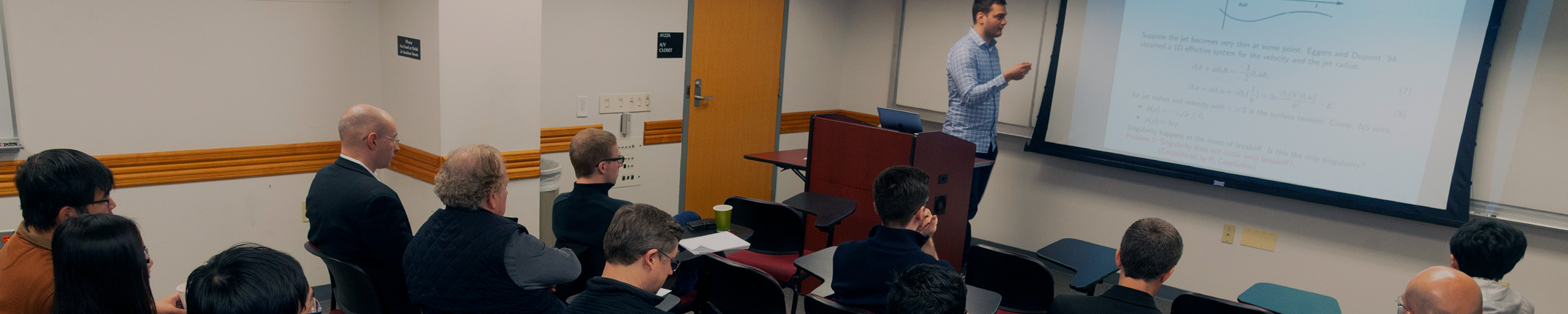
AOSC Seminar by Kris Karnauskas, 11/5/2026
AOSC Seminar
Kris Karnauskas
CU Boulder
Title
Faster Than We Thought: Equatorial Upwelling and the Future of the Tropical Pacific
Abstract
This fall, one of the strongest El Niño events on record is rearranging weather around
the world. Among other things, it helped hold off the Atlantic’s first hurricane until
October, the latest in the satellite era. El Niño is, in large part, the story of what happens
when equatorial upwelling—the slow rise of cold, deep water along the equator—stops
keeping the eastern Pacific cool. That same upwelling sustains a band of high biological
productivity, makes the region the ocean’s largest source of carbon dioxide to the
atmosphere, and may help explain why the eastern equatorial Pacific has barely
warmed, while climate models simulate and project enhanced warming there. Which
way the tropical Pacific goes matters for projections of hurricanes, rainfall, and even
global climate sensitivity.
Yet equatorial upwelling has been called “a tenet of faith among oceanographers,”
because its vertical velocities are too small to measure directly. In this talk, I will trace
six decades of attempts to estimate it and show why they disagree. Four decades of
surface drifter observations, corroborated by historical moorings, indicate that the time-
mean upwelling peaks at roughly 10 meters per day within a remarkably narrow band
along the equator. That is an order of magnitude faster than long assumed, several
times faster than in state-of-the-art climate models, and sharper than ocean reanalyses
depict. Idealized ocean model experiments point to why: the models are too “sticky”
(laterally viscous) near the equator, and finer grids alone do not fix it. Because faster
upwelling strengthens an ocean “thermostat” that resists warming in the eastern Pacific,
these results bear directly on climate projections. They also raise new questions about
simulating ENSO and about designing the next generation of ocean observations.
Bio
Kris Karnauskas is a Fellow of the Cooperative Institute for Research in Environmental
Sciences (CIRES) and an Associate Professor in the Department of Atmospheric and
Oceanic Sciences (ATOC) at the University of Colorado Boulder, with secondary faculty
appointments in the CU School of Medicine and the Colorado School of Public Health.
Prior to joining the CU Boulder faculty in 2015, Kris spent six years on the faculty of the
Woods Hole Oceanographic Institution (WHOI) and the MIT-WHOI Joint Program in
Oceanography (also teaching at Boston College) followed by sabbatical at the Institut
Pierre Simon Laplace (IPSL) in Paris, France through a Research Fellowship from the
Alfred P. Sloan Foundation. During the spring of 2022, Kris was on sabbatical at
Harvard University's Center for the Environment. Kris completed his B.S. at the
University of Wisconsin-Madison and Ph.D. at the University of Maryland-College Park,
both in Atmospheric and Oceanic Sciences, followed by a postdoctoral fellowship in
Ocean and Climate Physics at the Lamont-Doherty Earth Observatory of Columbia
University. Kris currently serves as Editor-in-Chief of Geophysical Research Letters and
co-chairs the Joint US CLIVAR/NIH Working Group on Climate & Health, and recently
served on the Scientific Steering Committee (SSC) of the U.S. Climate Variability and
Predictability Program (US CLIVAR). Kris was the recipient of the 2017 AGU Ocean
Sciences Early Career Award and the 2024 AGU Atmospheric Sciences Turco
Lectureship.
Contact
If you are not subscribed to seminar announcements and need a link to this online seminar please contact aosc-helper. You can also subscribe to weekly links and announcements below.
AOSC Seminar
Pre-seminar refreshment: N/A
Seminar: 3:30-4:30pm, Room: ATL 2400(only when in-person)
Meet-the-Speaker: 4:30-5:00pm, Room: ATL 3400(only when in-person) [For AOSC Students only]
[ Subscribe to receive seminar announcements | Email aosc-deptseminar@umd.edu to give a seminar ]