

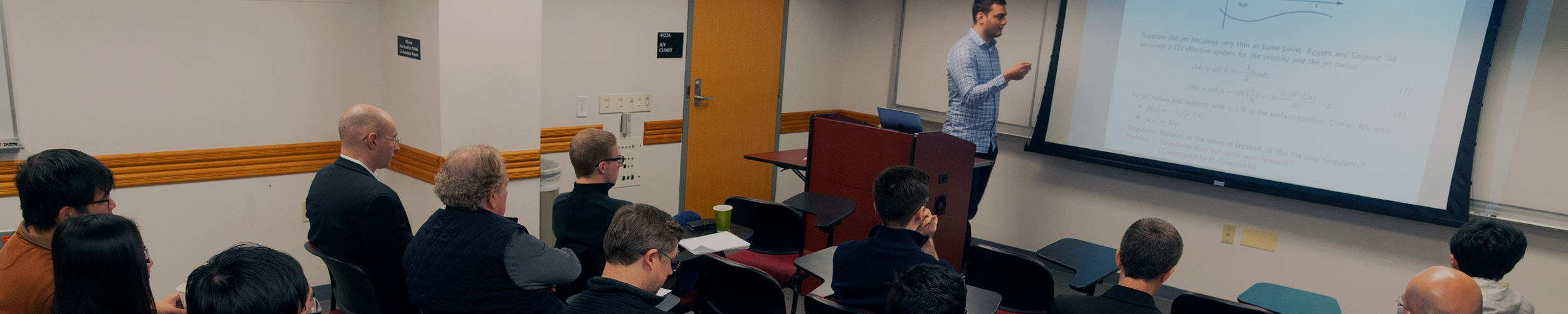
AOSC Seminar by Pengwang Zhai, 10/15/2026
AOSC Seminar
Pengwang Zhai
UMBC
Title
Seeing the Earth in Polarized Light: Radiative Transfer, Polarimetry, and Remote Sensing
Abstract
Light interacting with the Earth’s atmosphere, ocean, and land surface carries a wealth of information about our planet. Extracting this information, however, requires a quantitative understanding of how photons are scattered and absorbed as they propagate through complex natural environments. In this talk, I will introduce the fundamental role of light scattering and radiative transfer in remote sensing of the Earth system, with particular emphasis on the additional information provided by polarization. I will discuss advances in polarized radiative transfer modeling and their applications to the retrieval of aerosol and ocean properties from satellite observations. Recent developments in multi-angle polarimetry and hyperspectral measurements, including observations from NASA’s Plankton, Aerosol, Cloud, and ocean Ecosystem (PACE) mission, provide new opportunities to simultaneously characterize the atmosphere and ocean with unprecedented detail. I will highlight some of our recent efforts to connect fundamental radiative-transfer physics with these emerging remote-sensing capabilities and discuss opportunities and challenges for the next generation of Earth observations.
Bio
Contact
If you are not subscribed to seminar announcements and need a link to this online seminar please contact aosc-helper. You can also subscribe to weekly links and announcements below.
AOSC Seminar
Pre-seminar refreshment: N/A
Seminar: 3:30-4:30pm, Room: ATL 2400(only when in-person)
Meet-the-Speaker: 4:30-5:00pm, Room: ATL 3400(only when in-person) [For AOSC Students only]
[ Subscribe to receive seminar announcements | Email aosc-deptseminar@umd.edu to give a seminar ]