

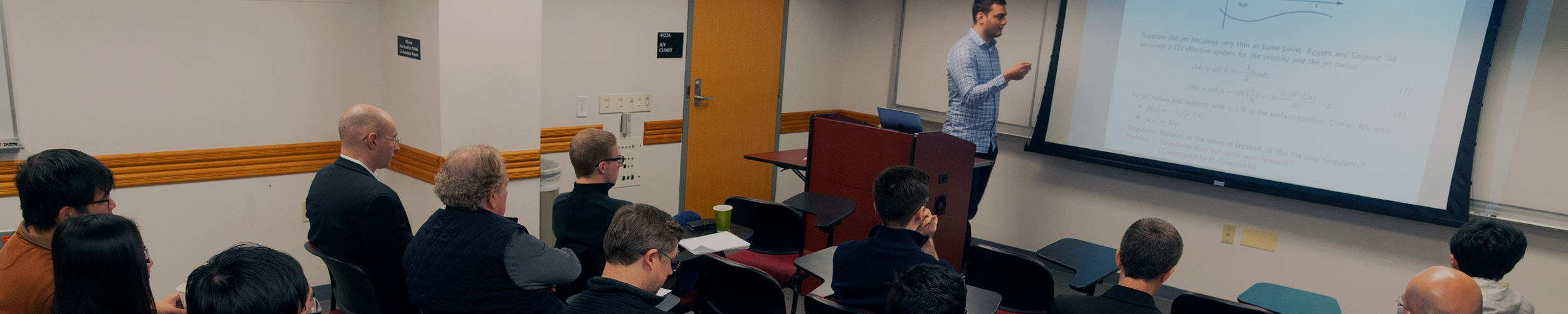
AOSC Seminar by David M. Straus, 2/19/2026
AOSC Seminar
David M. Straus
George Mason University
Title
Atmospheric Circulation Regimes: Basic Concepts and Applications (Old and New)
Abstract
The extratropical atmosphere is characterized by robust circulations which have time scales longer than those associated with developing baroclinic systems but shorter than a season. Such low-frequency variability is governed largely by nonlinear dynamics and is chaotic. A useful aspect of this low-frequency circulation is that it can often be described by just a few quasi-stationary states, broadly defined as recurrent or persistent large-scale structures. We call these states circulation regimes. The regimes are manifest in planetary scale patterns that strongly affect the structure of synoptic scale circulations. Since the large-scale regimes determine the background flow in which the weather systems develop, predicting their evolution on subseasonal time scales would enable us to predict the probability of weather statistics on time scales longer than the 1-2 weeks.
In the first part of this talk I will (very briefly) review the basic concepts behind circulation and weather regimes, from mechanistic models to dynamical systems theory. In addition, some of the variety of statistical techniques used, as well as their justification, will be presented, and some controversies touched upon. The various goals atmospheric scientists have had in applying circulation regime analysis include basic understanding of the atmospheric circulation, sub-seasonal predictability and prediction of weather statistics, and interpretation of ensemble forecasts.
In the second part, I will introduce an extension of the circulation regime paradigm to study the boreal winter storm tracks from the point of view of the horizontal momentum field, encompassing the full momentum covariance tensor. These measures can be taken to define the “barotropic storm tracks.” This work introduces a new approach that identifies geographical regions that are relatively homogeneous with respect to the frequency spectra of the zonal and meridional wind and their covariance, and suggests that the traditionally defined Atlantic and Pacific storm tracks are closely linked, and that we can understand this linkage between the Atlantic and Pacific Oceans in terms of Rossby wave packet propagation.
Bio
David became deeply interested in theoretical physics as an undergraduate, an interest that carried him through his PhD at Cornell University in solid state physics. His postdoc training in atmospheric science at MIT under Jule Charney introduced him to the then novel concept of multiple equilibria. Following a decade-long tenure at the Goddard Space Flight Center, David joined the Center for Ocean-Land-Atmosphere Interactions (COLA) and helped to launch it as an independent research organization. He has stayed with COLA through its journey: first at the University of Maryland, then as in independent organization, and finally at George Mason University. David has bben a Professor of Climate Dynamics in the Atmospheric, Oceanic and Earth Sciences Department at GMU since the early 2000’s, teaching and supervising PhD students in the Climate Dynamics PhD Program. His interest in teaching and training young scientists also led to participation in a number of mini-schools and workshops at the International Center for Theoretical Physics (ICTP) in Italy.
Contact
If you are not subscribed to seminar announcements and need a link to this online seminar please contact aosc-helper. You can also subscribe to weekly links and announcements below.
AOSC Seminar
Pre-seminar refreshment: N/A
Seminar: 3:30-4:30pm, Room: ATL 2400(only when in-person)
Meet-the-Speaker: 4:30-5:00pm, Room: ATL 3400(only when in-person) [For AOSC Students only]
[ Subscribe to receive seminar announcements | Email aosc-deptseminar@umd.edu to give a seminar ]